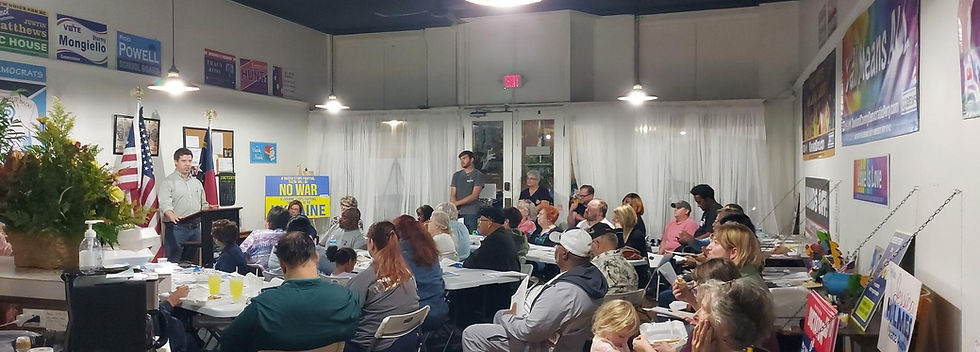
Speech from the Campaign Trail
My name is Brent Caldwell, and I am running for Congress in North Carolina’s Fourteenth District.
For much of my life I never saw myself running for office. Truthfully, I did not come to politics. Politics came to me. And as that happened, I found I needed to speak up. That I had something to say.
When my mother was called up to serve in the Iraq War and spent my junior year out of our home, I had to say something.
When in 2004 anti-gay ballot initiatives were cynically used to drive turnout and people in my Southern high school took that as license to bully our LGBTQ classmates, I spoke a little louder. I organized to protect my gay and lesbian classmates and spoke against the Iraq War.
In college, as that war unraveled and the economy collapsed, I committed
myself to building up progressives in the South.
After graduation I traveled the
country working as an activist, campaign staffer, and labor organizer. After earning a Master’s degree at the London School of Economics, my wife and I settled in North Carolina. I studied law at Duke, started a family, and began my legal career.
But in light of recent events, I must speak up again. There are things that need to be said loudly and plainly that I am not hearing and needed work I do not see being done.
This work is urgent. In three counties in the district – Gaston, Rutherford, and
Burke – income growth has lagged national growth for the last fifty years. At the
same time home prices and rents have nearly tripled in real terms. Childcare costs
are through the roof. And healthcare costs are seven times – yes seven times – what they were in 1970.
Some parts of Mecklenburg are doing great. But we cannot let America’s booming tech and financial sectors allow us to ignore the question of whether this growth is shared. In many of our small towns, our rural counties, in those desiccated town squares, we see it is not.
This will not be fixed by merely reviving the past. Instead, we must strive to realize past ideals. Our problems arise from the fact that there we are not one nation today but instead there are two Americas, one that sets the rules and the rest that, for now, have to live with them.
Next year marks the two hundred fiftieth anniversary of the signing of the Declaration of Independence. Consideration of the values in that document will give us many of the solutions we require.
We must ask:
What does liberty mean? With respect to a woman being able to choose what
happens in her own body? With respect to people arranging their marital relations as
they see fit?
What does the rule of law mean? Does it mean a President can order prosecutions of his opponents and defy the courts? Certainly not.
What does democracy mean? Does it include people like Tim Moore choosing their voters and gerrymandering a district to such an extent they feel they do not even have to campaign or debate? Of course not.
What is honor in public life? And where has it gone?
This is the moment for such discussion. We are choosing the one hundred twentieth Congress. It is time again for America to decide what this revolution is all about. Is it merely, as has happened so many times before, one set of elites pushing out another only to advantage themselves? Or is it a new birth of freedom, where people can stand on their own two feet and chart their own way in the world?
The same people increasing the cost of living and nickel and diming us are the ones limiting our democratic ability to do anything about it. People instinctively know this is a new form of the aristocratic impulse America and the South have overcome before.
The people of the district feel it in rent that rises faster than paychecks, in childcare they can barely afford, in healthcare bills that land like a punch to the gut. They see it as opportunity pools in a few zip codes and their children are drawn away, often for good, unable to fulfill their ambitions closer to home.
Don’t you yourself feel that now is a time for choosing? We can rebuild an economy that rewards work, restore a democracy that respects voters, and make it possible for families to build their futures here at home. Or we can keep sliding down a path where a few people write the rules and everyone else pays the price. My family and I are all in on this race because we know which path we choose.
Won’t you join us?